Dali Nushu Exhibition
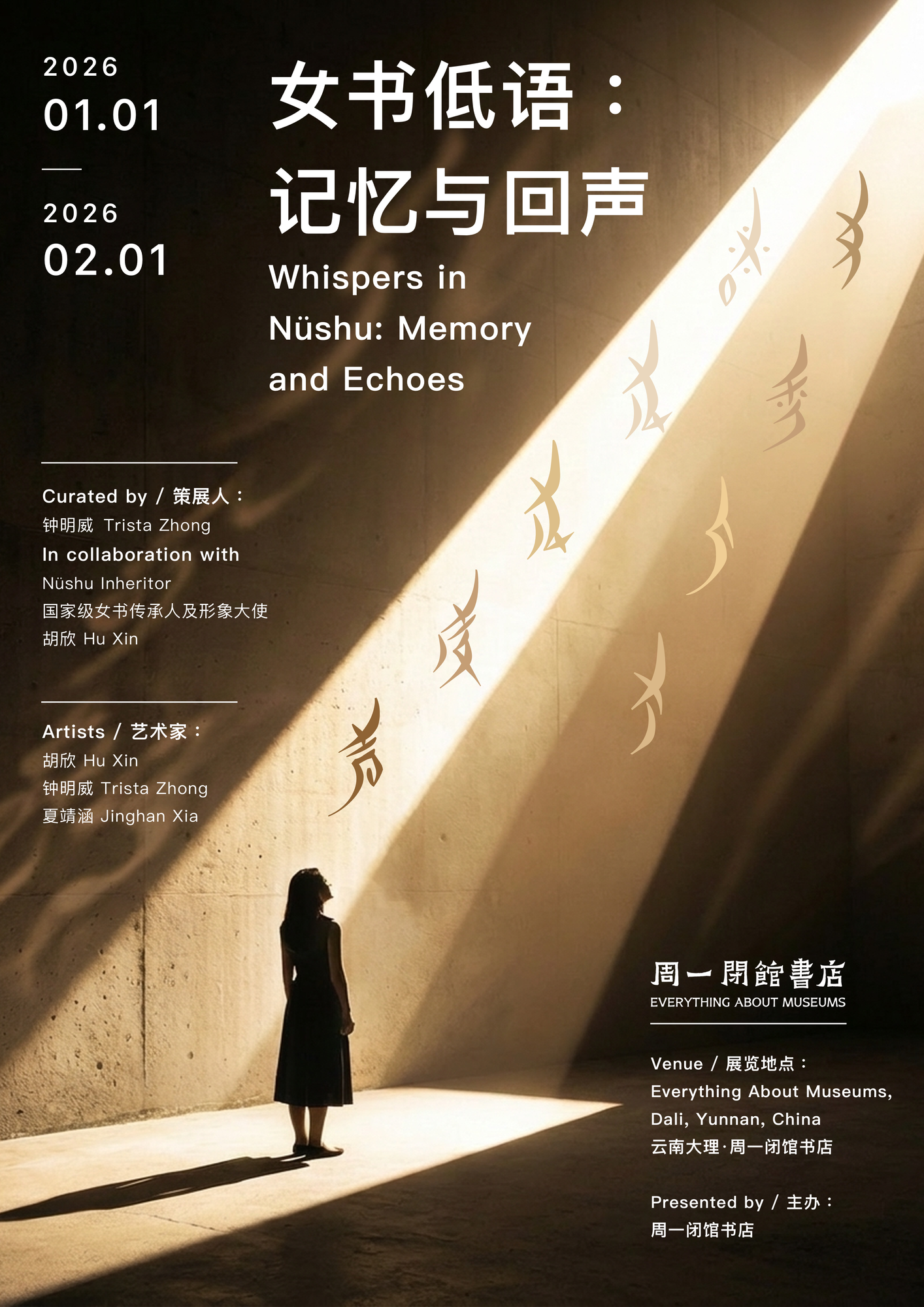
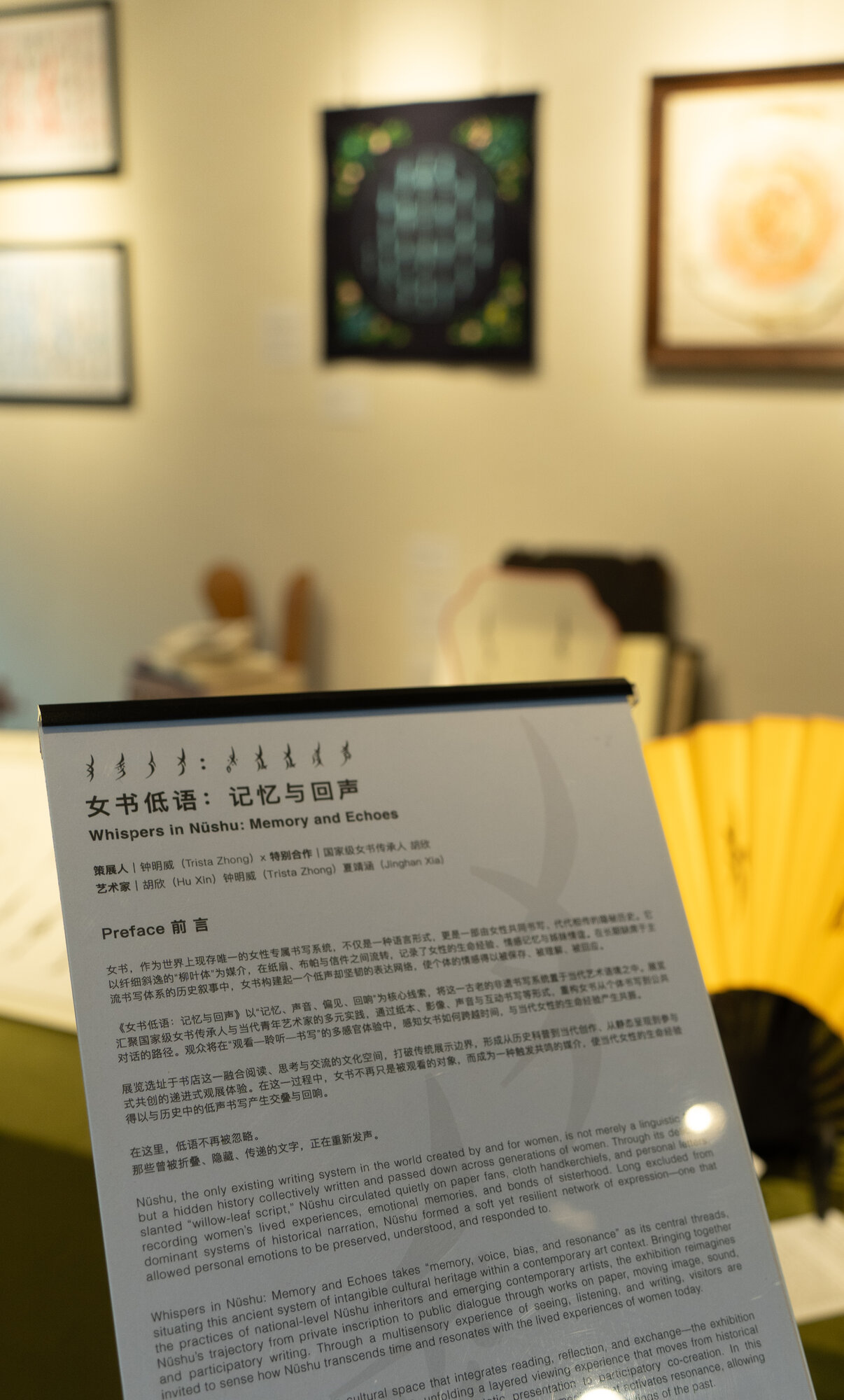
Whispers in Nüshu: Memory and Echoes
Artists|Hu xin, Mingwei (Trista) Zhong, Jinghan Xia
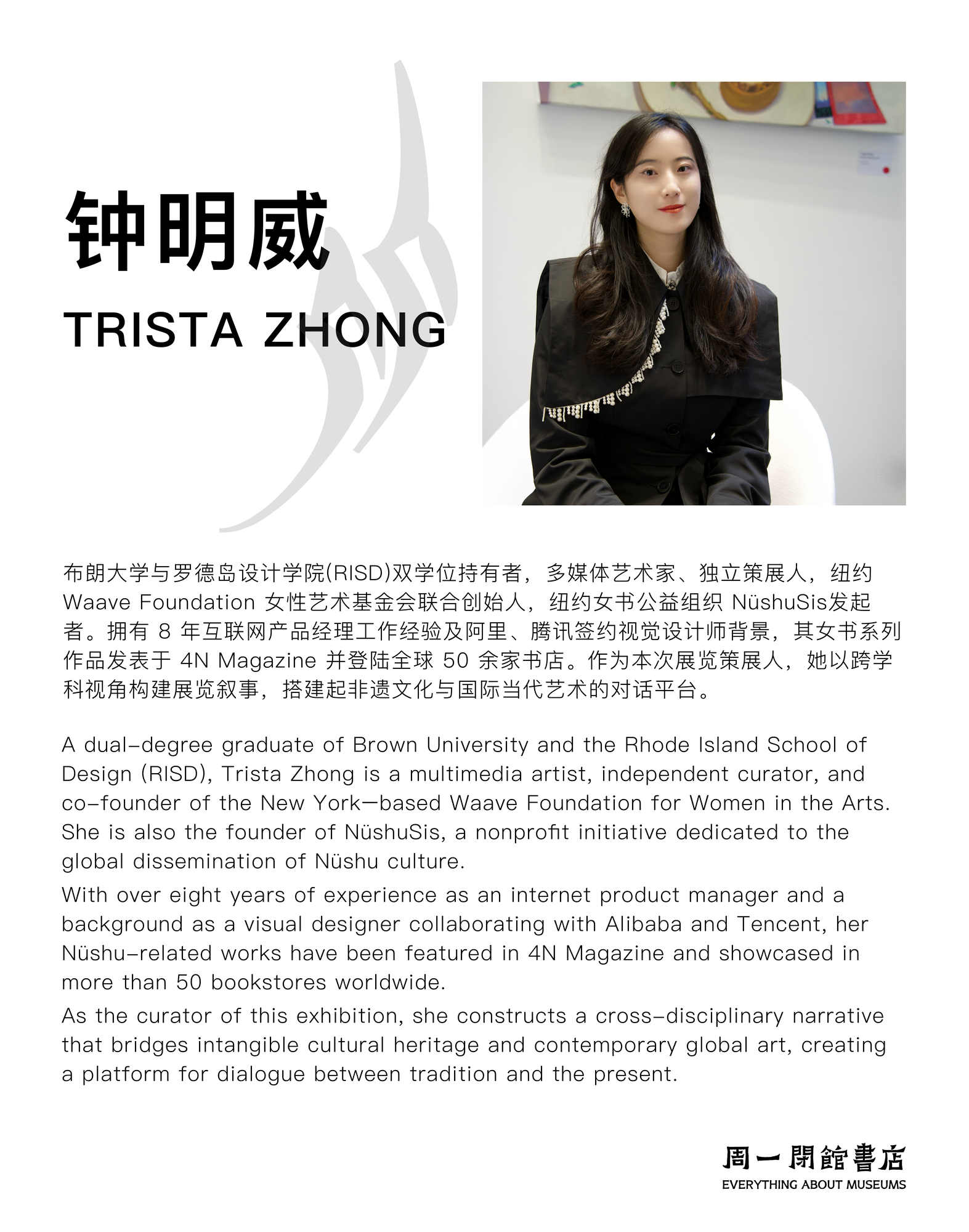
Curated by Mingwei (Trista) Zhong
Whispers in Nüshu is an intimate exhibition centered on Nüshu—the world's only surviving writing system created and passed down exclusively by women.
Rather than presenting Nüshu as a historical artifact, I approach it as an emotional language: a quiet technology of care, resilience, and sisterhood. This exhibition invites visitors into a multisensory experience of viewing, listening, and writing, where historical archives, contemporary artworks, and handwritten responses coexist within a shared emotional field.
Through ink, embroidery, mineral pigments, incense ash, soil, and participatory installations, the works trace how women's private whispers travel across time and re-emerge as contemporary echoes. Here, Nüshu is not something to be observed from a distance, but something to be felt, written, and gently held.
This is not an exhibition that speaks loudly. It whispers—inviting you to come closer, to listen carefully, and to find quiet strength in the presence of others.
📍 Dali, Yunnan, China
January 1 – February 1, 2026
About Everything Museum
Free admission
Whispers in Nüshu: Memory and Echoes
A Gentle Embrace of Feminine Power
I have always believed that some forms of power do not announce themselves loudly. They arrive quietly, almost imperceptibly—like a whisper close to the ear, or an embrace that you only realize you needed after it has already happened.
Whispers in Nüshu: Memory and Echoes is one such encounter.
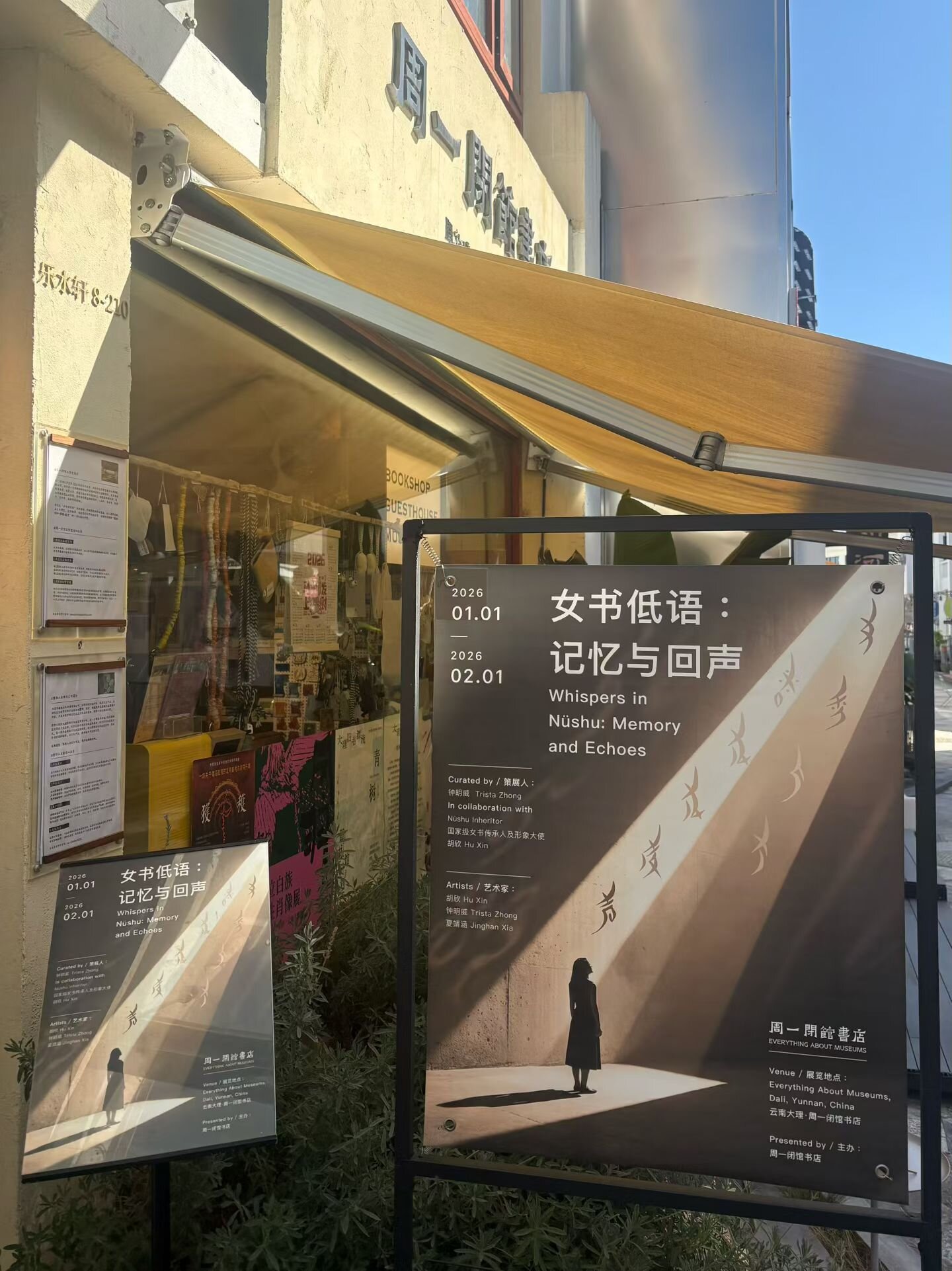
The exhibition opened on January 1, 2026, at 周一闭馆书店/ About Everything Museum in Dali, Yunnan. It centers on Nüshu—the world's only surviving writing system created and used exclusively by women. Yet rather than presenting Nüshu as a distant cultural artifact or an academic subject, I wanted this exhibition to feel intimate, warm, and bodily felt. To me, Nüshu is not only a script; it is an emotional technology passed from woman to woman across generations.
Curating this exhibition felt less like constructing a narrative and more like holding space—for voices that were once whispered, folded, embroidered, hidden, and shared only among sisters.
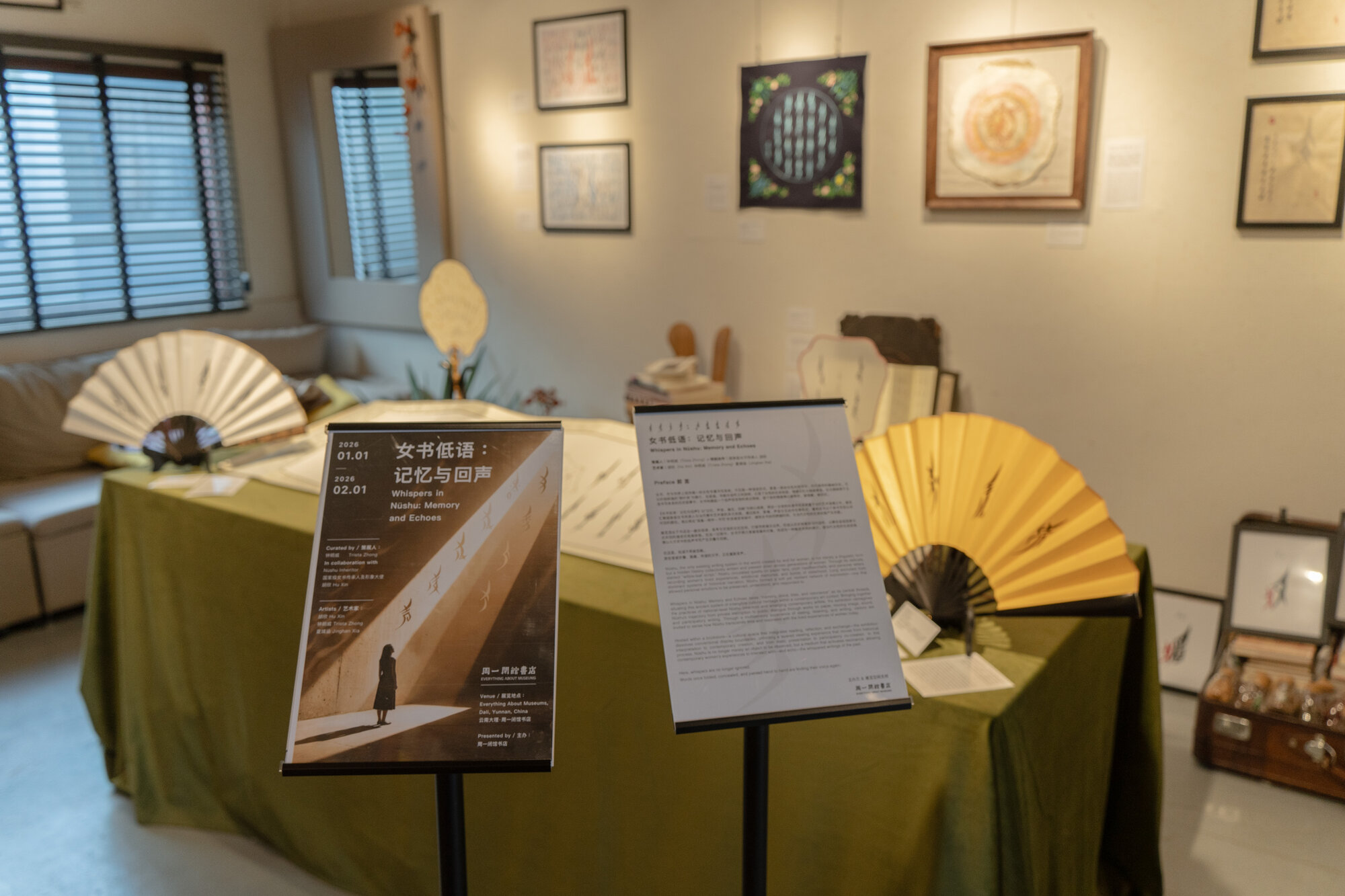
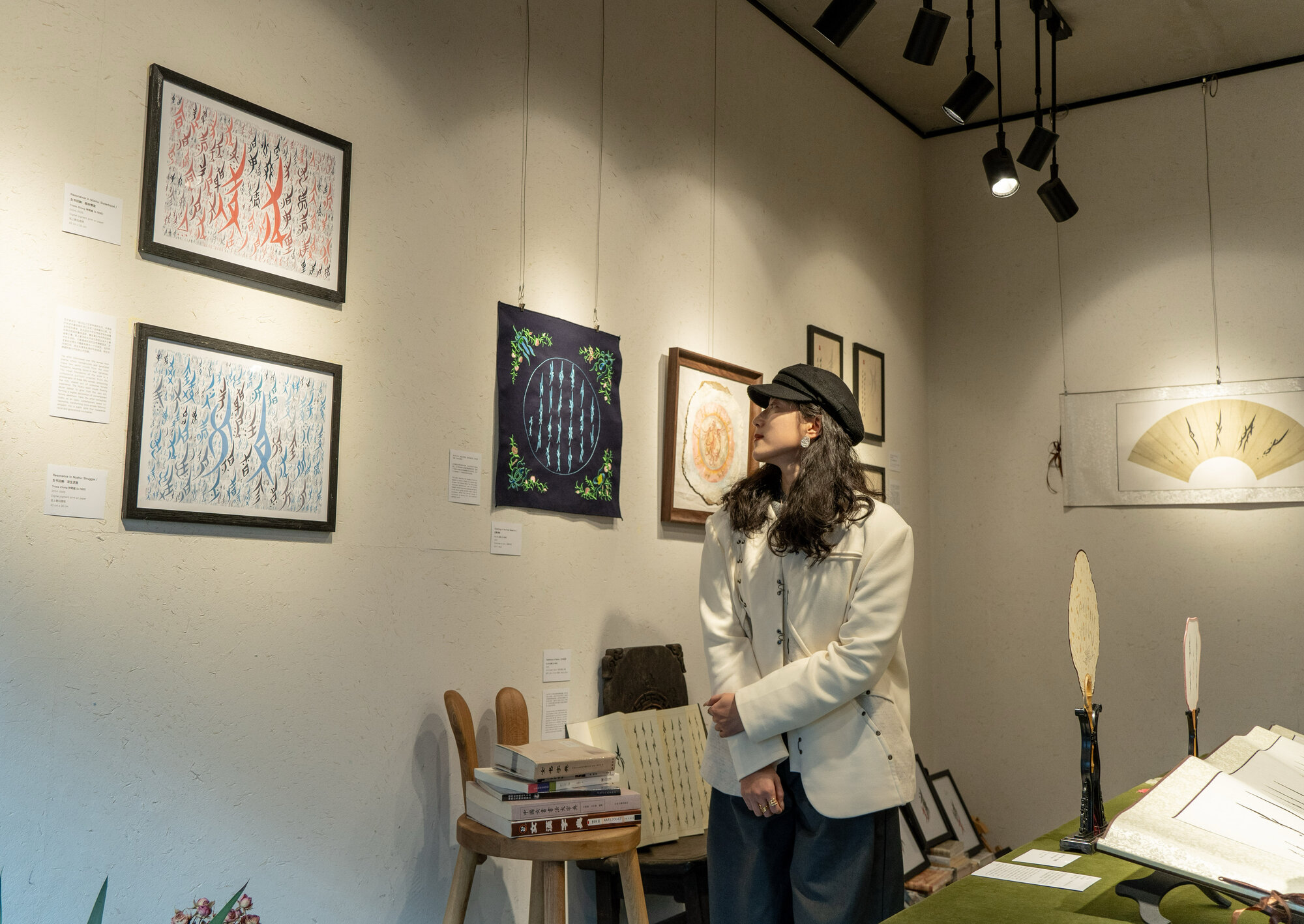
The exhibition unfolds inside the hybrid space of About Everything Museum, where visitors step into what I consider an emotional energy field shaped by Nüshu. I designed the experience around a simple yet powerful sensory sequence: viewing — listening — writing.
The historical archive section traces how Nüshu functioned as a private emotional bond among women—written on fans, cloth, letters, and everyday objects. Nearby, contemporary works reinterpret this heritage through modern materials and methodologies: data visualization, mineral pigments, embroidery, incense ash, and participatory installations.

Rather than isolating history from the present, I wanted the two to breathe together. Nüshu is not frozen in time; it continues to resonate, transform, and respond to contemporary questions of gender, memory, and collective experience.
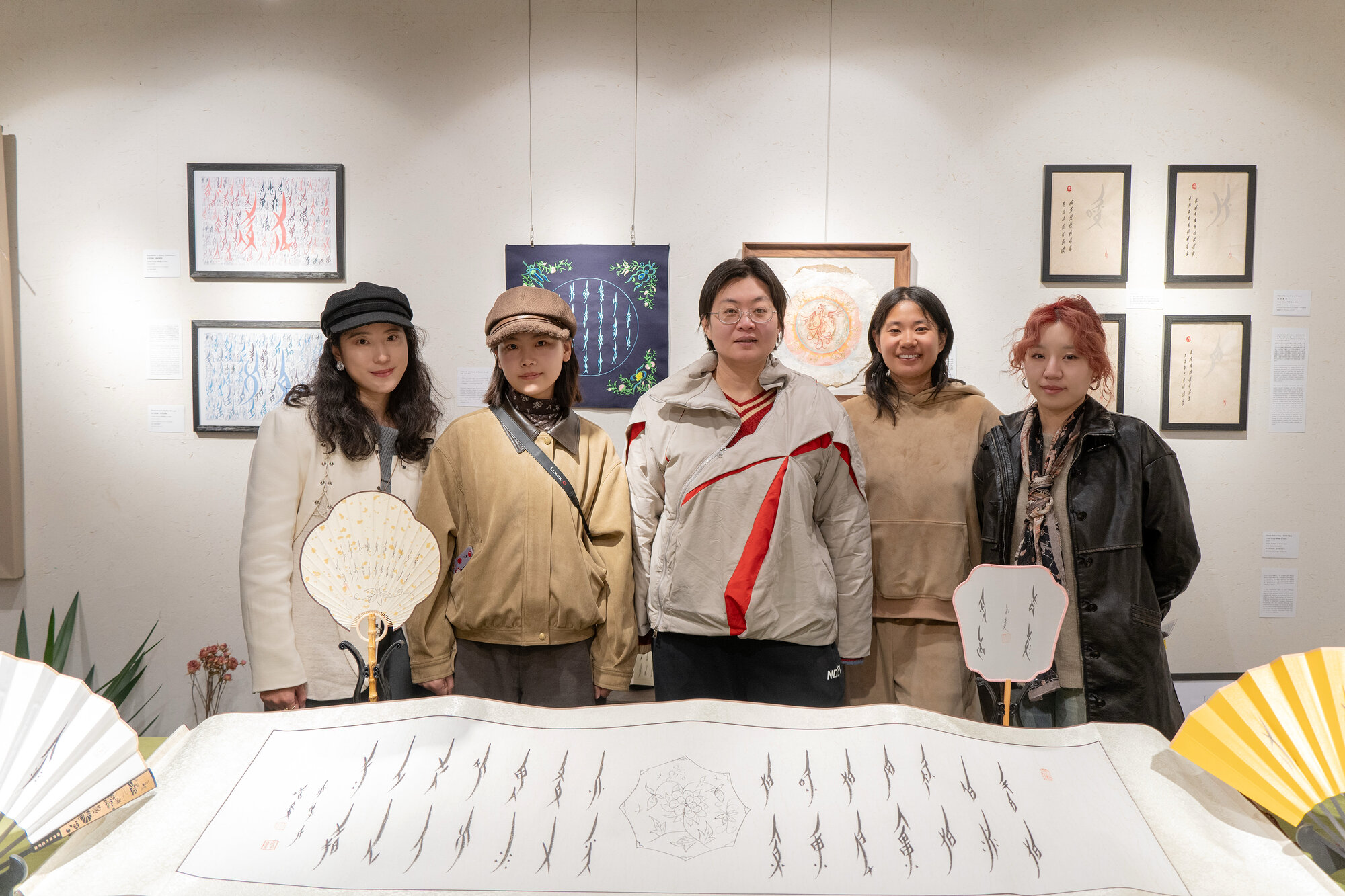
At the exhibition site, curator Trista Zhong and artist Jinghan Xia personally guide visitors through the space, offering in-depth interpretations of the cultural meanings behind each work.

At the heart of the exhibition is an interactive writing area, which has unexpectedly become its most emotionally charged space.
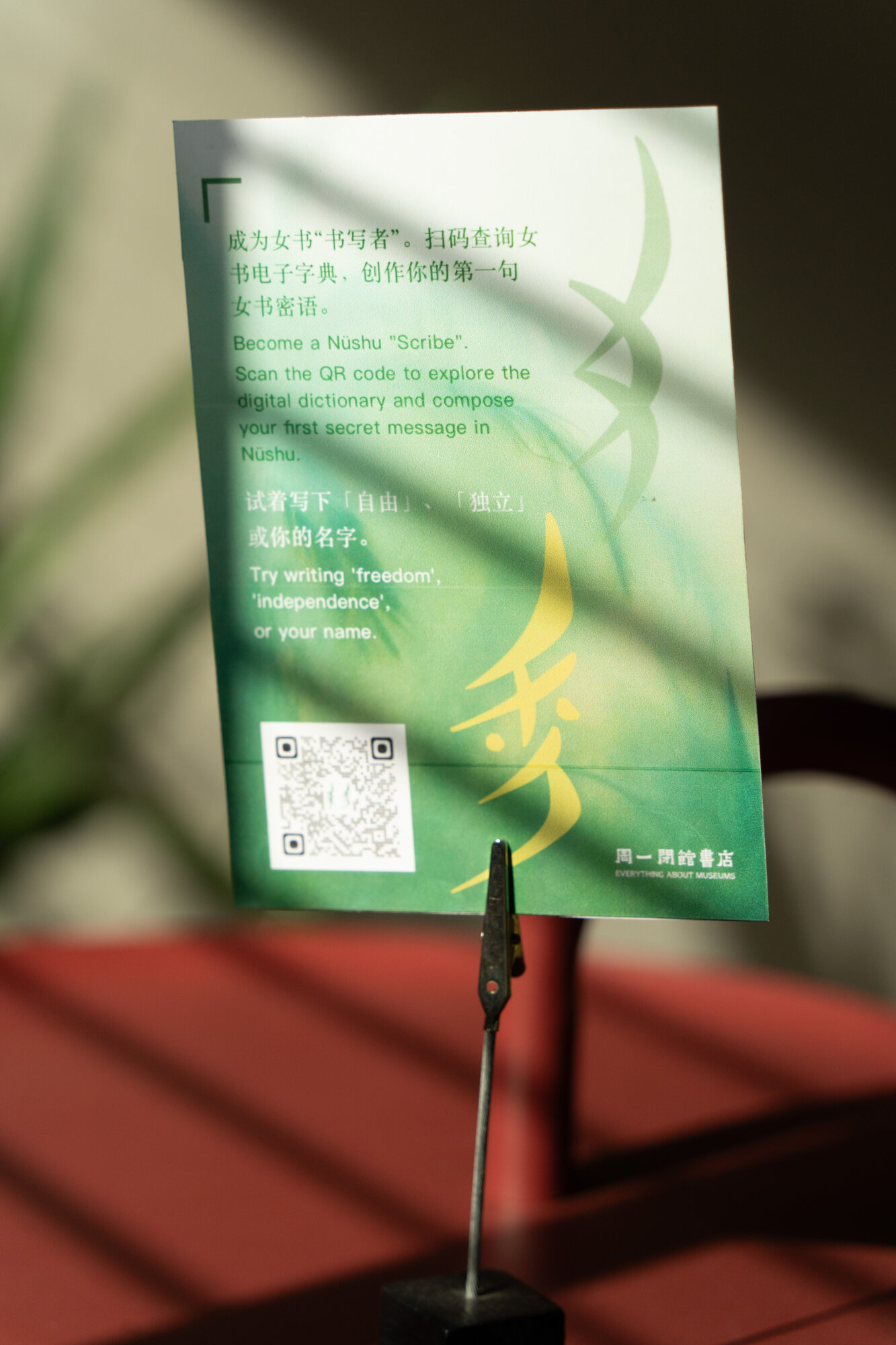
Visitors are invited to scan a QR code to access a digital Nüshu dictionary, to slowly handwrite characters, and to hang their writings onto a suspended curtain installation. This gesture quietly echoes the original tradition of Nüshu as a private language shared among sisters—except that here, “sisters” expands to include anyone moved by women's stories.
Each handwritten word—freedom, courage, endurance, love—joins those written by strangers before them. Over time, the curtain becomes a living archive, where contemporary voices coexist with historical documents and artworks, forming a cross-temporal tapestry of whispered solidarity.

One visitor later wrote to me:
“Standing before the curtain, seeing words written by people I would never meet, I suddenly felt that I was not alone. It felt like being gently held.”
Moments like this remind me why I curate.
Artists & Works
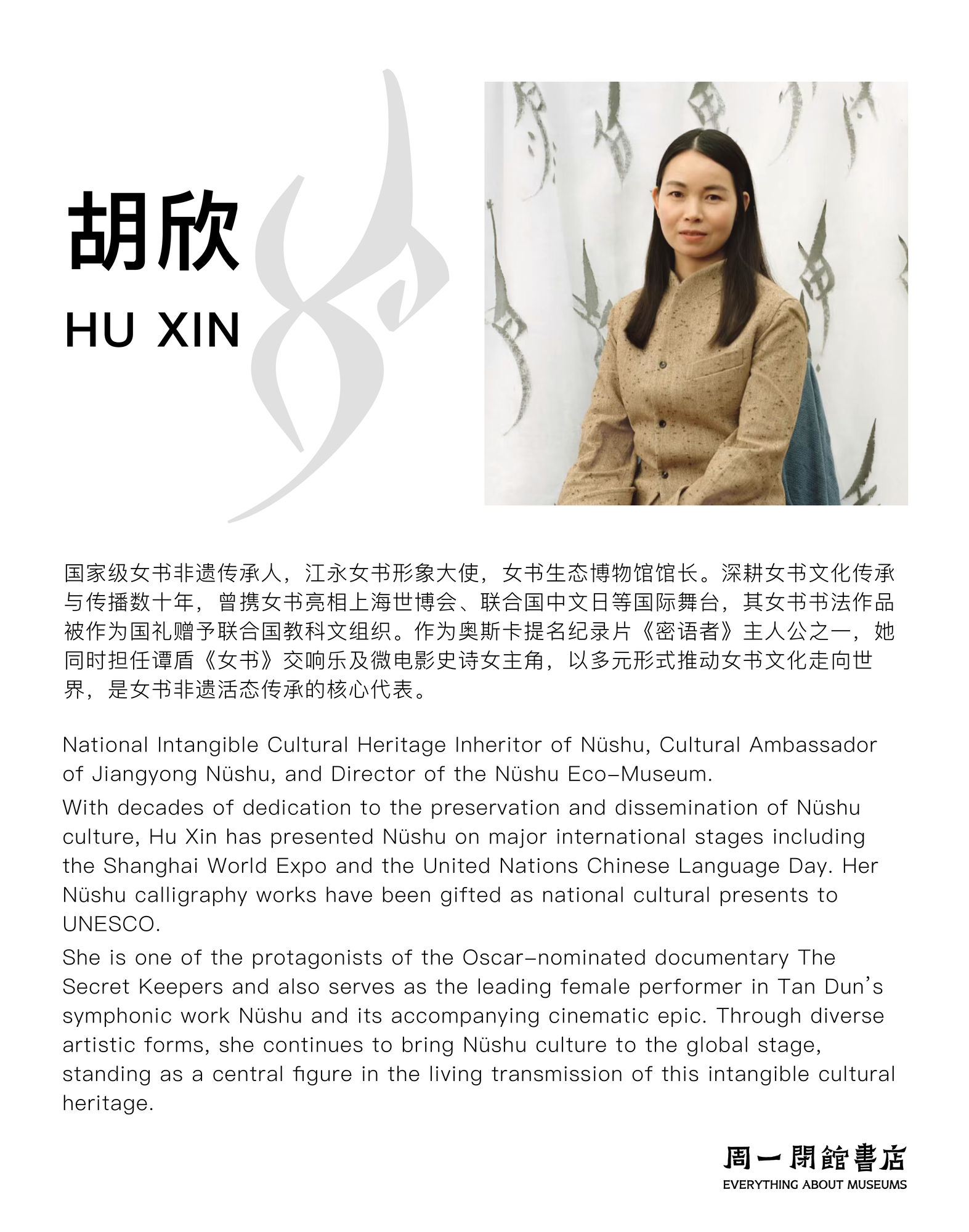
This exhibition is created in close collaboration with Hu Xin, a national-level inheritor of Nüshu, whose works anchor the exhibition in lineage and continuity.
In Testimony of Nüshu, the phrase “Who says women are of no use” appears not as protest, but as quiet insistence—a declaration carried by the elegance of ink and the intimacy of the folding fan format.
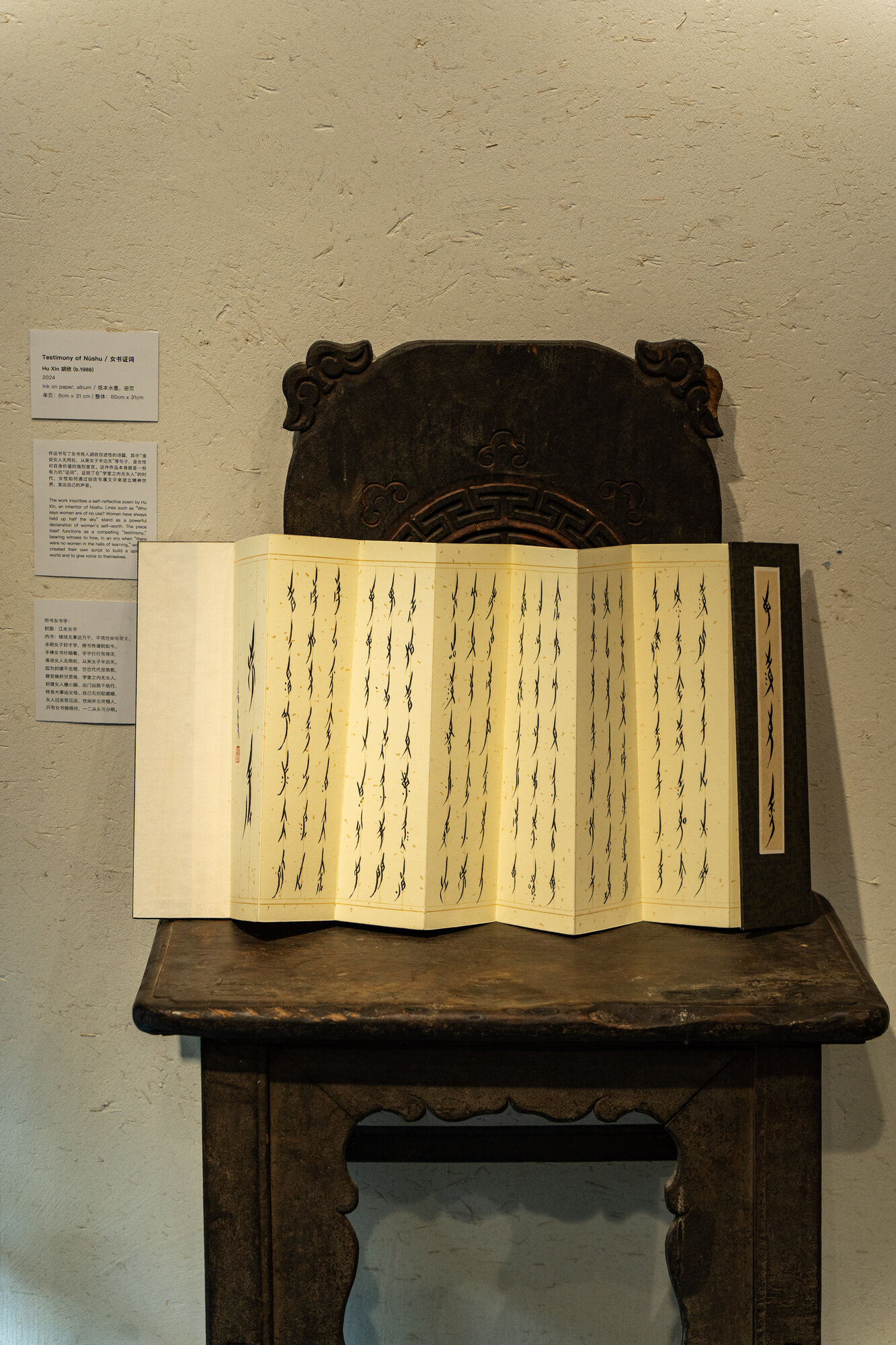
Testimony of Nüshu / 女书证词
Hu Xin 胡欣 (b.1988)
2024
Ink on paper, album / 纸本水墨,册页
Single page: 8 cm × 31 cm | Overall: 80 cm × 31 cm
Promising Future reimagines the symbolic fan as an arc-shaped ink composition filled with bamboo. Bamboo's hollow structure, jointed growth, and evergreen resilience mirror the flexible endurance of feminine life force. To me, this work is both a blessing for the future of Nüshu and a meditation on how women's strength survives through adaptability rather than domination.
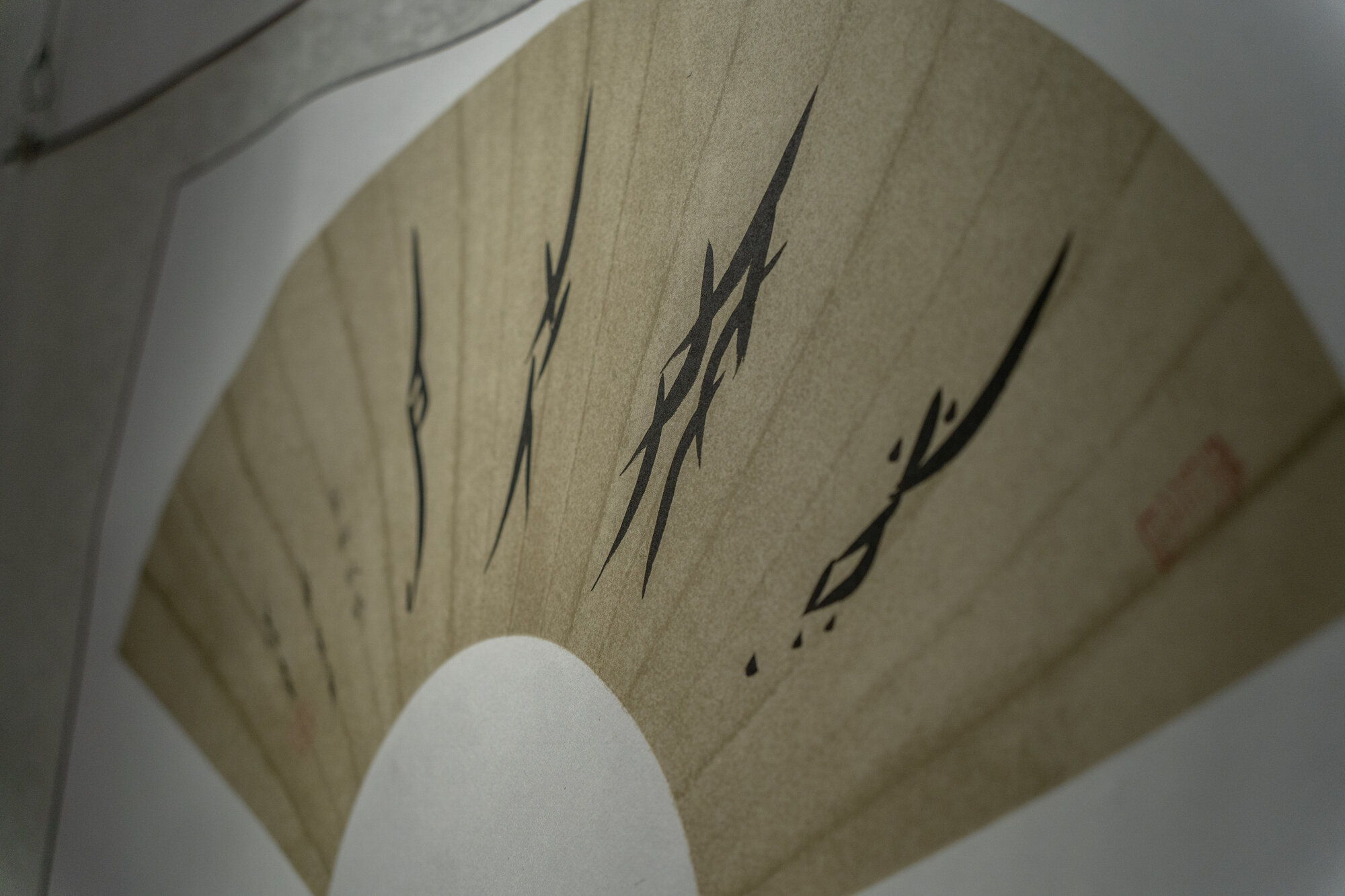
Promising Future / 前程似锦
Hu Xin 胡欣 (b.1988)
2024
Ink on paper / 纸本水墨
105 cm × 41 cm
In Chanting of the Four Seasons, embroidery replaces brushwork. Needle and thread become a continuation of calligraphy, merging women's domestic labor with literary and artistic authorship—an act of reclamation as much as creation.
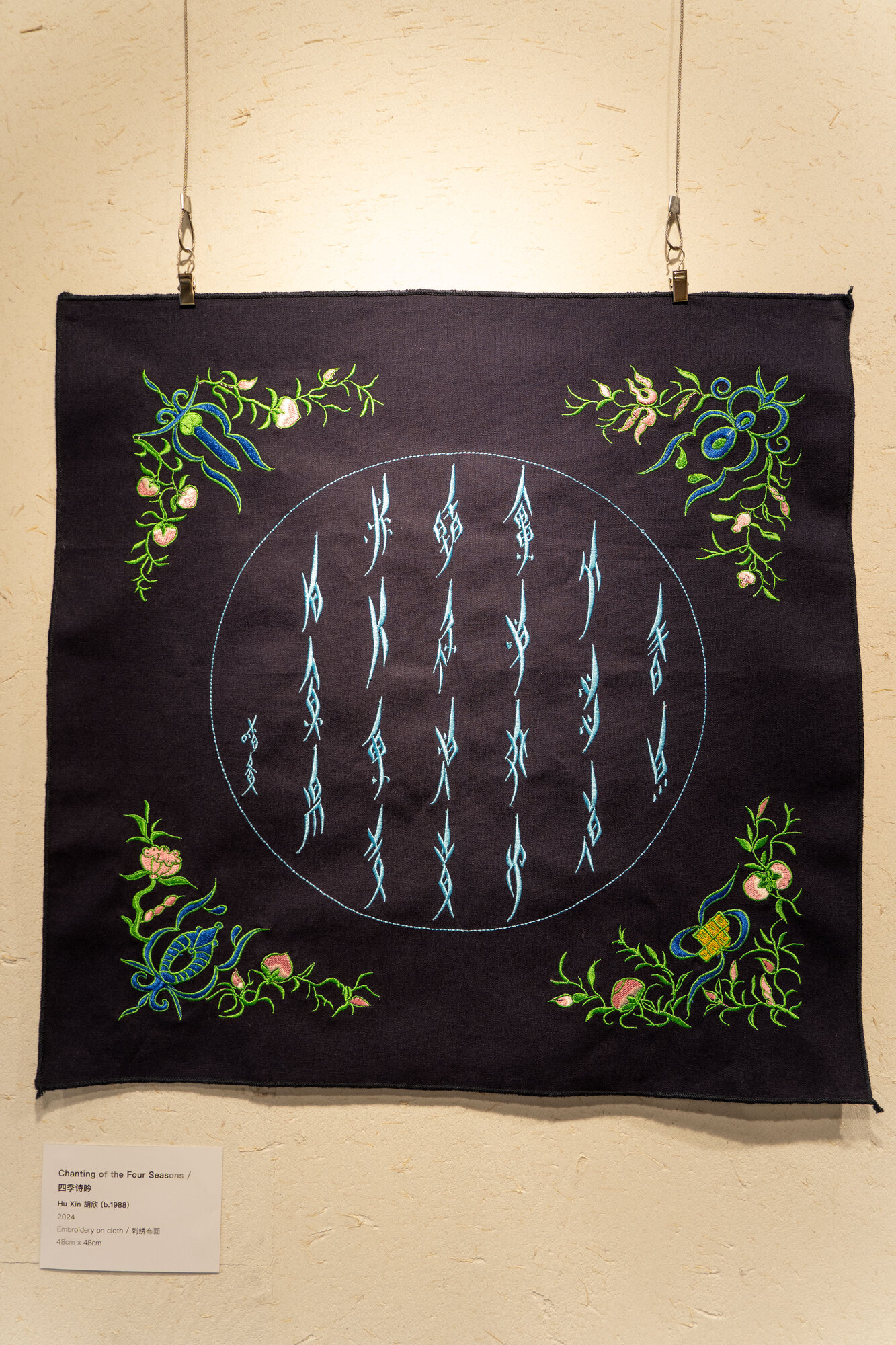
Chanting of the Four Seasons / 四季诗吟
Hu Xin 胡欣 (b.1988)
2024
Embroidery on cloth / 刺绣布面
48 cm × 48 cm
My own work in the exhibition emerges from long-term research and listening.
Resonance in Nüshu: Sisterhood & Struggle translates oral histories from over fifty women into a word-cloud composition. Behind the floating Nüshu characters are stitched portraits of the narrators, suggesting that individual voices rise from a shared ground of experience. The piece functions as a visual archive—fragmented, collective, unfinished.
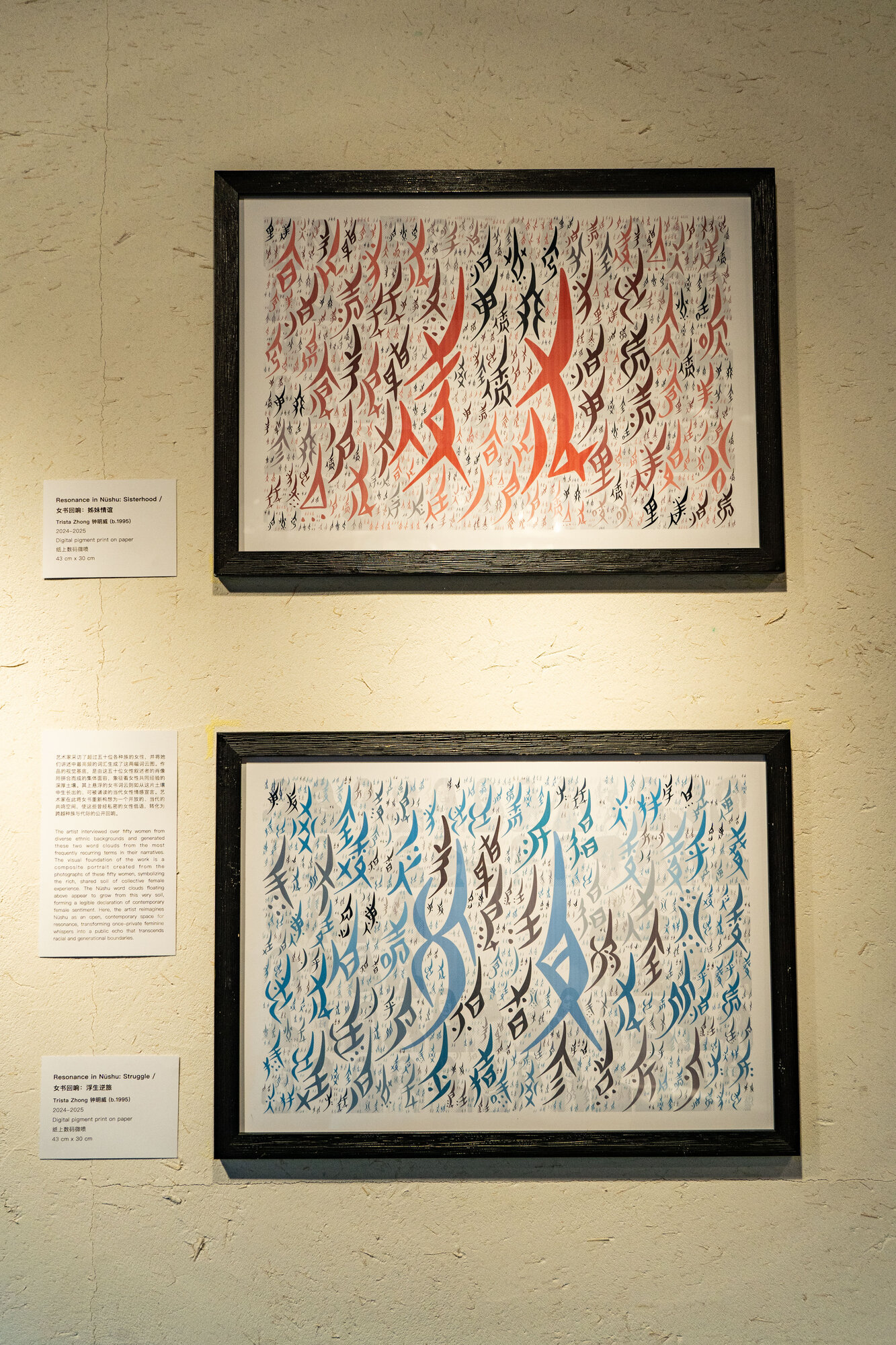
Resonance in Nüshu: Sisterhood & Struggle / 女书回响:姊妹情谊&浮生逆旅
Trista Zhong 钟明威 (b.1995)
2024–2025
Digital pigment print on paper / 纸上数码微喷
43 cm × 30 cm
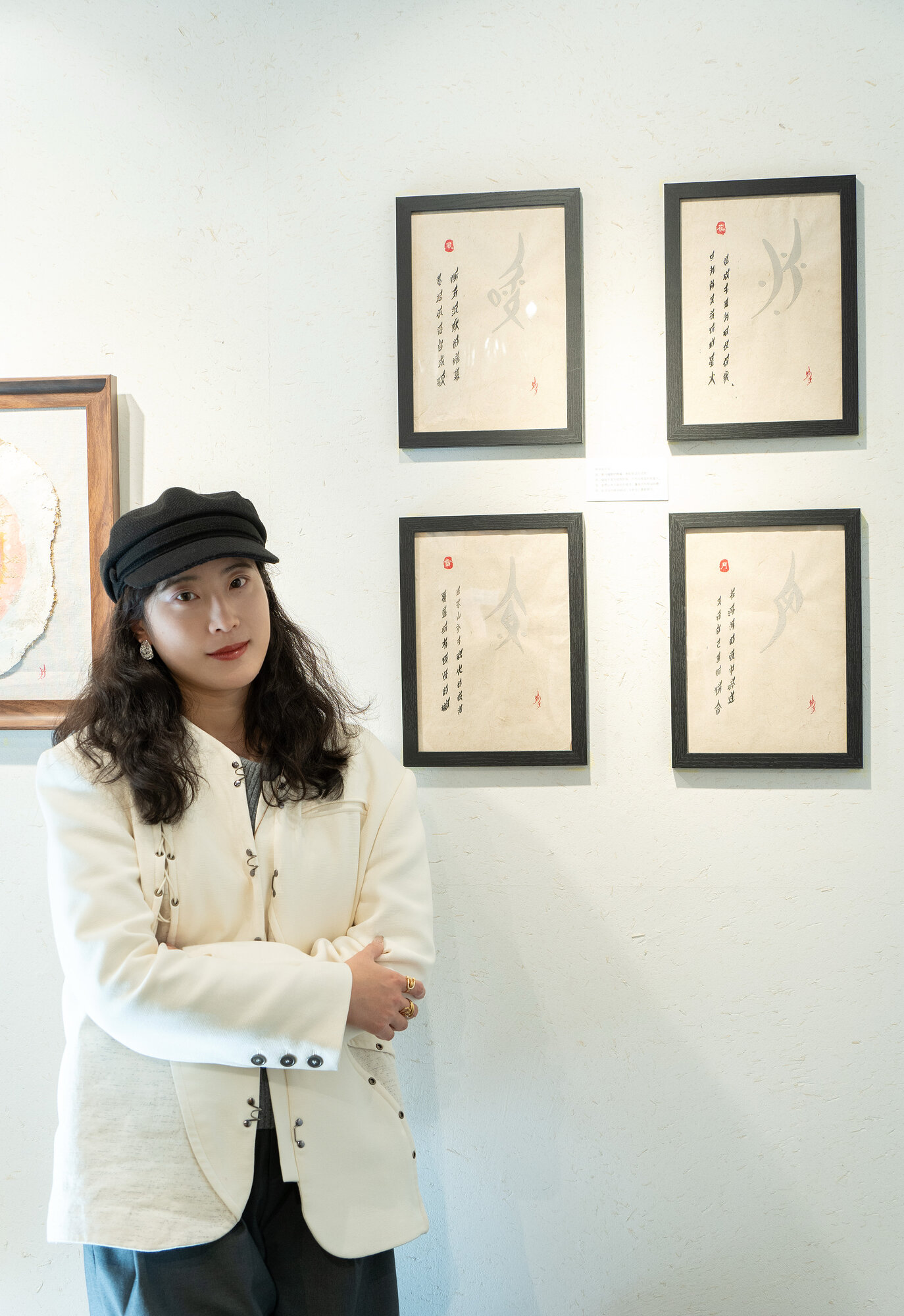
In Wind · Flower · Snow · Moon, I used incense ash collected from Jizhao Hermitage in Dali to write poetic imagery onto Yunnan hemp paper. Incense ash, as both offering and residue, connects spiritual devotion with the passing of time. Through this material, Dali's landscape enters into a quiet dialogue with Nüshu characters, grounding the script within local memory and natural cycles.
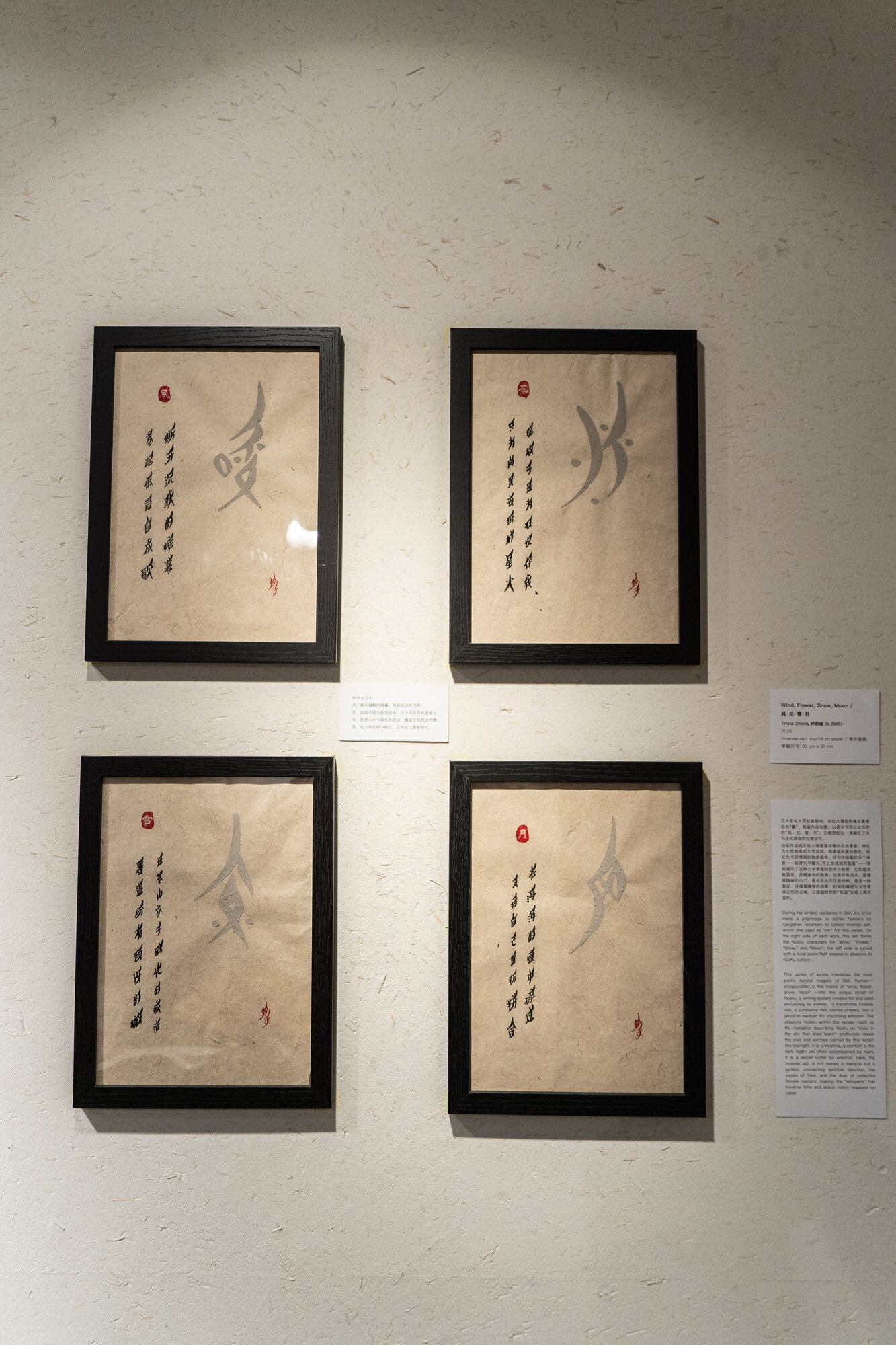
Wind, Flower, Snow, Moon / 风·花·雪·月
Trista Zhong 钟明威 (b.1995)
2025
Incense-ash imprint on paper / 香灰版画
Single piece size: 30 cm × 21 cm
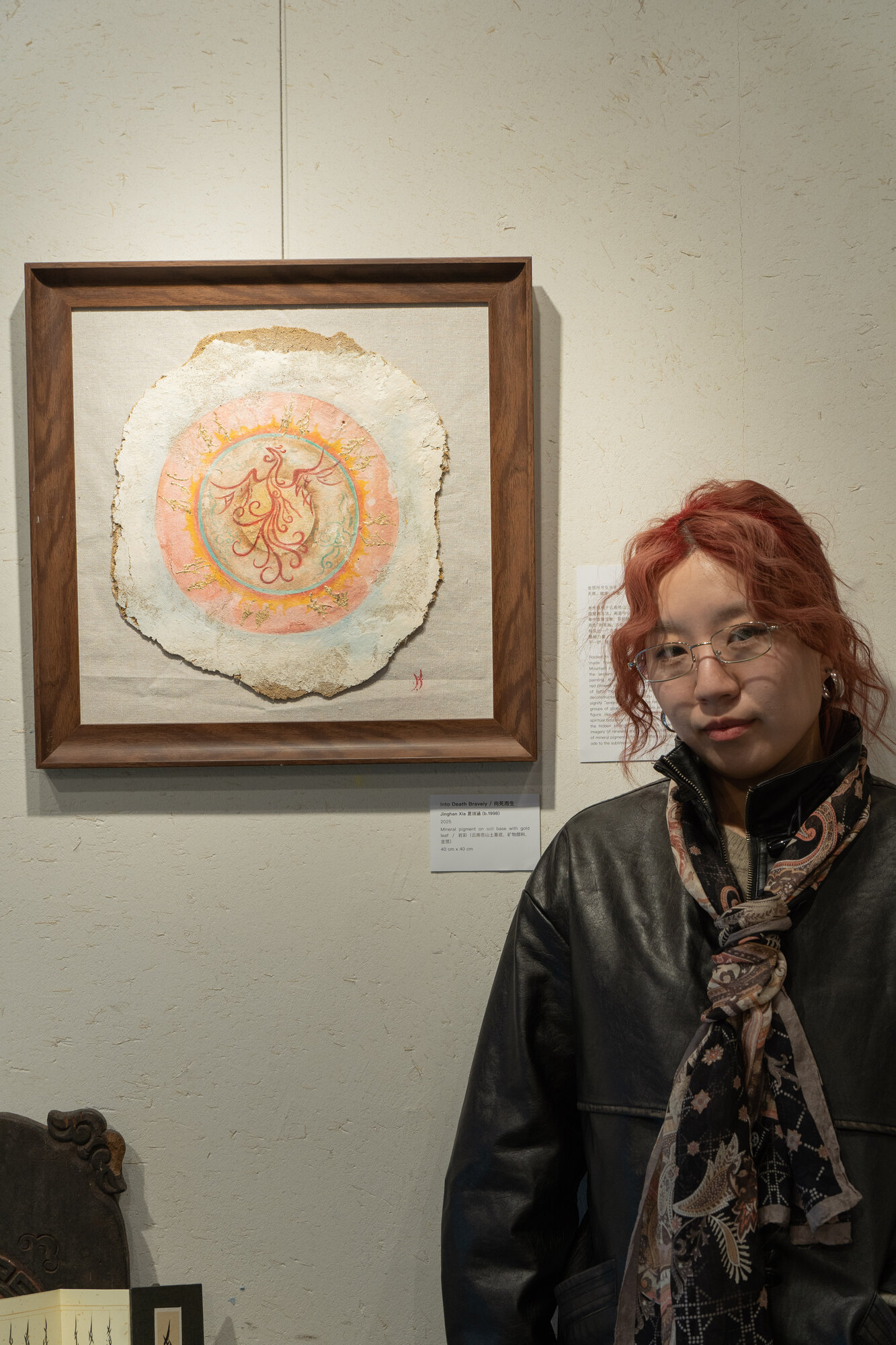
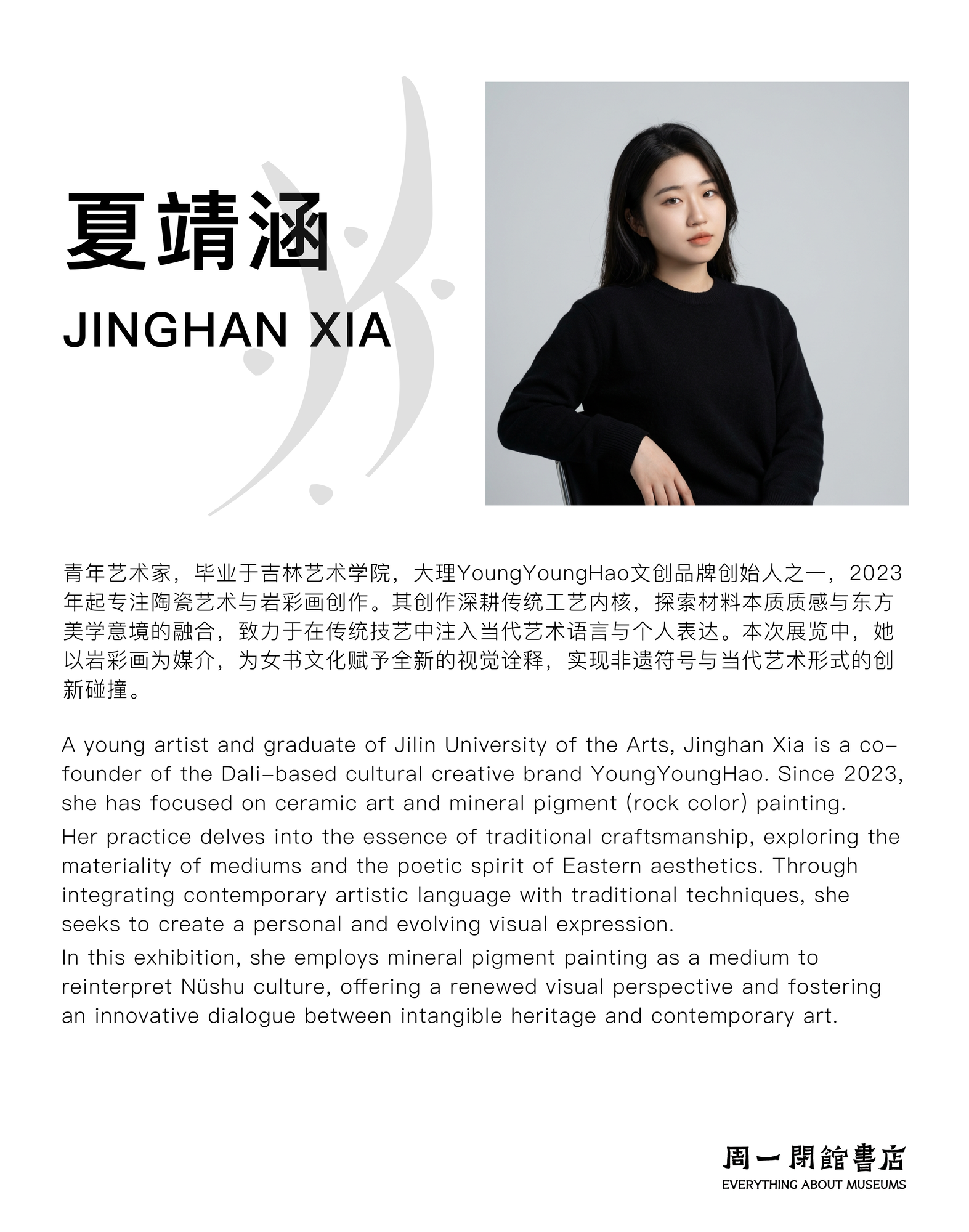
Artist Jinghan Xia extends this material exploration in Into Death Bravely, using soil from Cangshan Mountain as the base, inscribed with Nüshu in gold leaf. Here, earth itself becomes a metaphor for death, rebirth, and transformation. Intangible cultural heritage is no longer preserved behind glass—it is reactivated through contemporary experimentation.
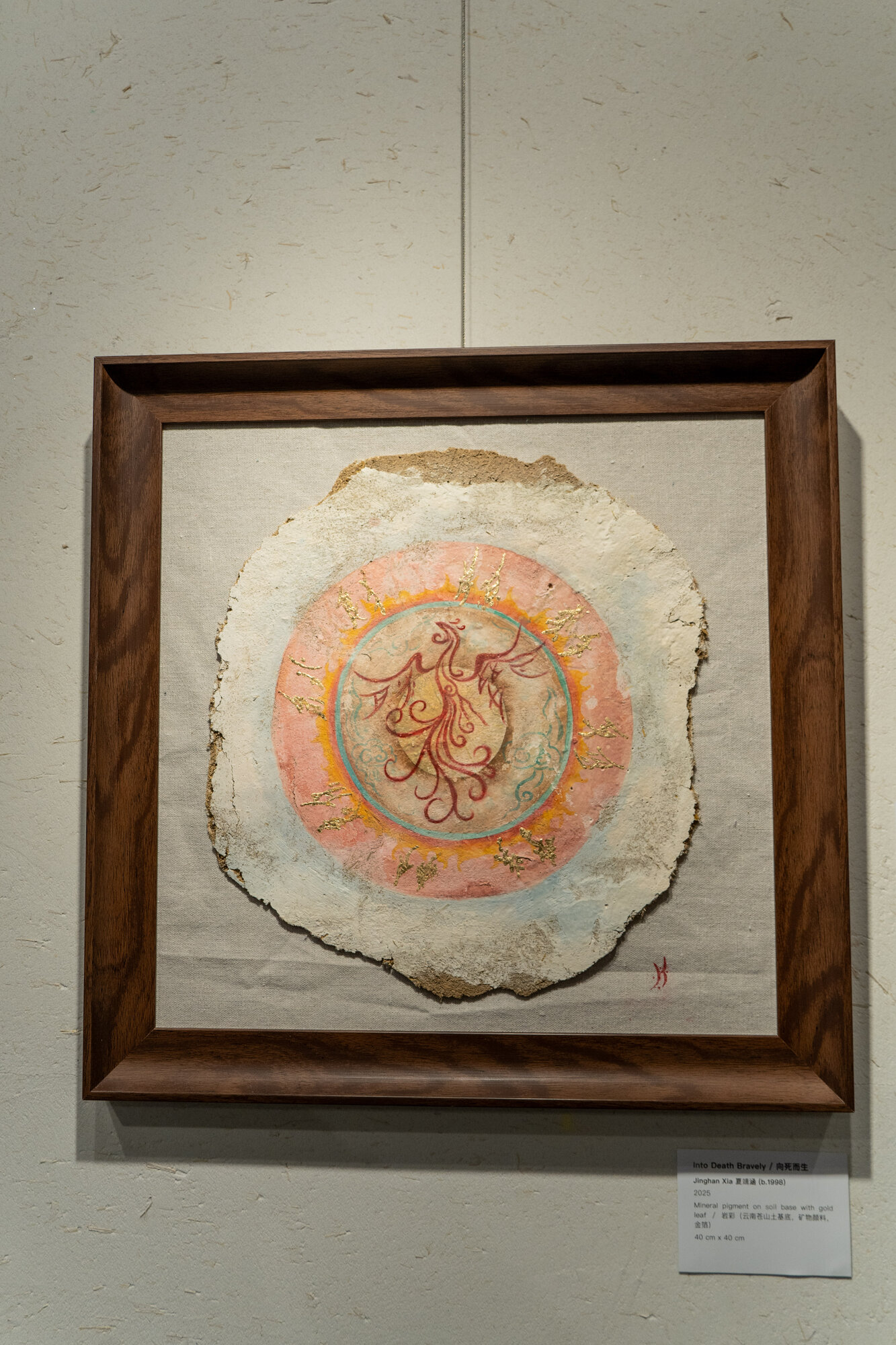
Into Death Bravely / 向死而生
Jinghan Xia 夏靖涵 (b.1998)
2025
Mineral pigment on soil base with gold leaf / 岩彩
(Cangshan soil base from Yunnan, mineral pigments, gold leaf)
40 cm × 40 cm
Whispers in Nüshu traces Nüshu's journey from private confessions to public presence. This is not an academic display or an attempt to monumentalize history. It is a curatorial practice rooted in care—care for slowness, intimacy, and emotional truth.
As the title suggests, this exhibition does not shout. It whispers. Like water, it surrounds rather than confronts. It invites you to come closer, to listen carefully, and to recognize a form of strength that sustains rather than overwhelms.
If you are in Dali seeking a quiet place to spend time with yourself—to listen, to write, to feel accompanied—I warmly invite you to visit. The space is small, but it holds enough room to gently soothe restlessness and fatigue.

Sometimes, a whisper is all we need to remember we are not alone.
Whispers in Nüshu is not meant to be fully understood in one visit.
I hope it is something you enter slowly—
something that listens back when you write,
and stays with you quietly after you leave.
⸻
Dates: January 1 – February 1, 2026
Opening Hours: 10:00 AM – 7:00 PM
Venue: 周一闭馆书店/ About Everything Museum, Dali, Yunnan, China
Admission: Free
All exhibited works are available for collection.
For inquiries, please contact me directly.